Proven Bestsellers – Developed for Real-World Applications
Our products are developed where processes are tested, systems are operated, and processes are optimized.
They are the result of our own development work: precise, robust, and proven in practice.
Our Resin Analysis as a Solution
We have been known industry-wide for our resin analyses for decades. They are one of our most sought-after services – which is no surprise, as they validly solve various challenges for our customers.


System Problem Analysis
For troubleshooting in your operational system

Goods Inward Inspection
For independent chemical measurement of the batch and comparison of different resin types
Resin Type Selection
Which resin offers the best price-performance ratio for my application?
The resin datasheet often shows values that are not essential in an application. For example, the kinetics of a resin type are not specified but lead to different ion removal rates. Even more crucial is the regenerability, which dominates operating costs. Therefore, an experimental resin comparison is worthwhile here.
What role does the resin type play in the chemical costs of my system?
In principle, combined circuits of weak and strong stages yield the best regenerant utilization and chemical costs. On the anion side, the combined circuit is common, but the quaternization degrees (strongly basic capacity fractions) of the various “weakly basic” types from different manufacturers are quite different. This impacts chemical costs but can be measured in the resin laboratory.
Unfortunately, the frequent absence of the weakly acidic stage also too often increases costs. Similarly, sometimes excessively high cross-linking degrees are used in the strongly acidic stage. Here, too, resin analysis provides clarity, as we can even measure these cross-linking degrees.
Which resin combination allows me to operate most economically?
In principle, combined circuits of weak and strong stages yield the best regenerant utilization and chemical costs. It is also almost always more economical to choose this combined circuit on both the anion and cation sides. In the anion combined circuit, the lowest quaternization degrees in the weakly basic stage are fundamentally the most economical. We have been able to prove this theoretically as well as metrologically.
Ongoing Operation
When is the optimal time for resin replacement for economic reasons?
If you use the traditional operating method with constant regenerants, the strongly acidic resins (SACs) as well as the double or weakly basic (DBAs, WBAs) should be replaced after approx. 10-12 years, the WACs after >30 years, but the strongly basic (SBAs) after approx. 8 years. Otherwise, operation becomes very expensive.
If you use a variable regenerant calculation (e.g., via a Mi-Vision system), you can use the resins much longer with ease, as they hardly have any lifespan-dependent chemical consumption anymore. The end of life is reached when, for example, the system’s own water consumption has increased too much.
Can I optimize my chemical costs myself?
Yes, by adapting the regenerant settings to the variable loading capacities. This is best done fully automatically, for example, by a Mi-Vision system. If the regenerant excess is always kept constant by such process control, the system always operates with consistently optimal costs and, most importantly, independently of resin age.
Errors in Ongoing Operation
I have new resins, but the system is limping. Can resin analysis help?
It can and often does, but this cannot be guaranteed. We also experience situations where a customer sends resin samples as suspected culprits, but the measurement of the samples shows that the resins are fine. This means that you then have to look for the error in technical components. But you always get the certainty of argumentation, no matter what the outcome.
What exactly does cross-contamination cause?
Cross-contamination, caused by fouling of anion exchangers with organic polysulfuric acids, leads to a significant and increasing extension of washing time in the circulation wash and usually then also shows a conductivity hump a few minutes after production startup. Further reasons for cross-contamination are cation fragments in the weakly basic stage or even complete CAT beads within it.
What does fouling mean?
Anion exchangers tend to absorb organic anions or macromolecules when raw water contains high organic content. In both cases, adsorptive uptake occurs, which can only be regenerated with difficulty by caustic regeneration. Molecules accumulate more and more here, leading to the blockage of resin pores and surfaces and – in the case of organic acid anions – to cross-contamination.
Which resin classes are susceptible to fouling?
Cation exchangers usually show only minor fouling effects. Anion exchangers are more sensitive, as many organic molecules are also anions. Here, gel-type SBAs quickly show blockages because the surfaces are quickly occupied. Macroporous SBAs are more tolerant because the internal surfaces are much larger, and the fouling effect proceeds significantly slower. Acrylate-based anion exchangers are more regenerable and do not absorb organic molecules as strongly. Thus, they are not as susceptible to fouling, but they also do not achieve the same good residual values for TOC. A dilemma.
If the inspection says: Everything is OK. What's next?
If there is a problem in your system, but the resins have been measured and found to be good, it is possible, for example, to temporarily connect a measuring device to your system that records almost all measurable data and usually allows very quick conclusions about the malfunction of the line (e.g., a mobile Mi-Vision system). It is also possible to carry out a system audit, which very often also detects multiple errors or enables cost optimizations or general technical improvements.
System Optimization
Is a system conversion of my old system worthwhile?
This is indeed a calculation task that can usually be solved well. Many measures lead to calculable savings, which can then be evaluated by a payback calculation. The goal of every activity is therefore the determination of savings effects or payback periods. Ultimately, you must be able to save operating costs or operate the system more safely or reliably.
Is a process change to RO, for example, worthwhile?
This is also a fairly simple calculation task. The result depends on a few specific cost rates in your operation. Important here are, for example, the raw water and wastewater costs. With the help of these cost rates, the available technologies can be well compared. The investments do not differ significantly, but the operating costs can be very different. Therefore, a preliminary review of the idea is definitely worthwhile.
We offer equipment and services for measurement tasks that were previously unsolvable.
Not every challenge can be answered with standard solutions.
In many projects, we have found that certain components, measurement systems, or setups are missing – or do not function as they should in operation.
Our measurement technology solutions arose precisely from these requirements. They complement our process engineering work where our own solutions are technically more sensible than commercially available ones. Our new technologies are now also available to you for these demanding measurement tasks in your own systems, both for rental and purchase.


Our patented measuring devices
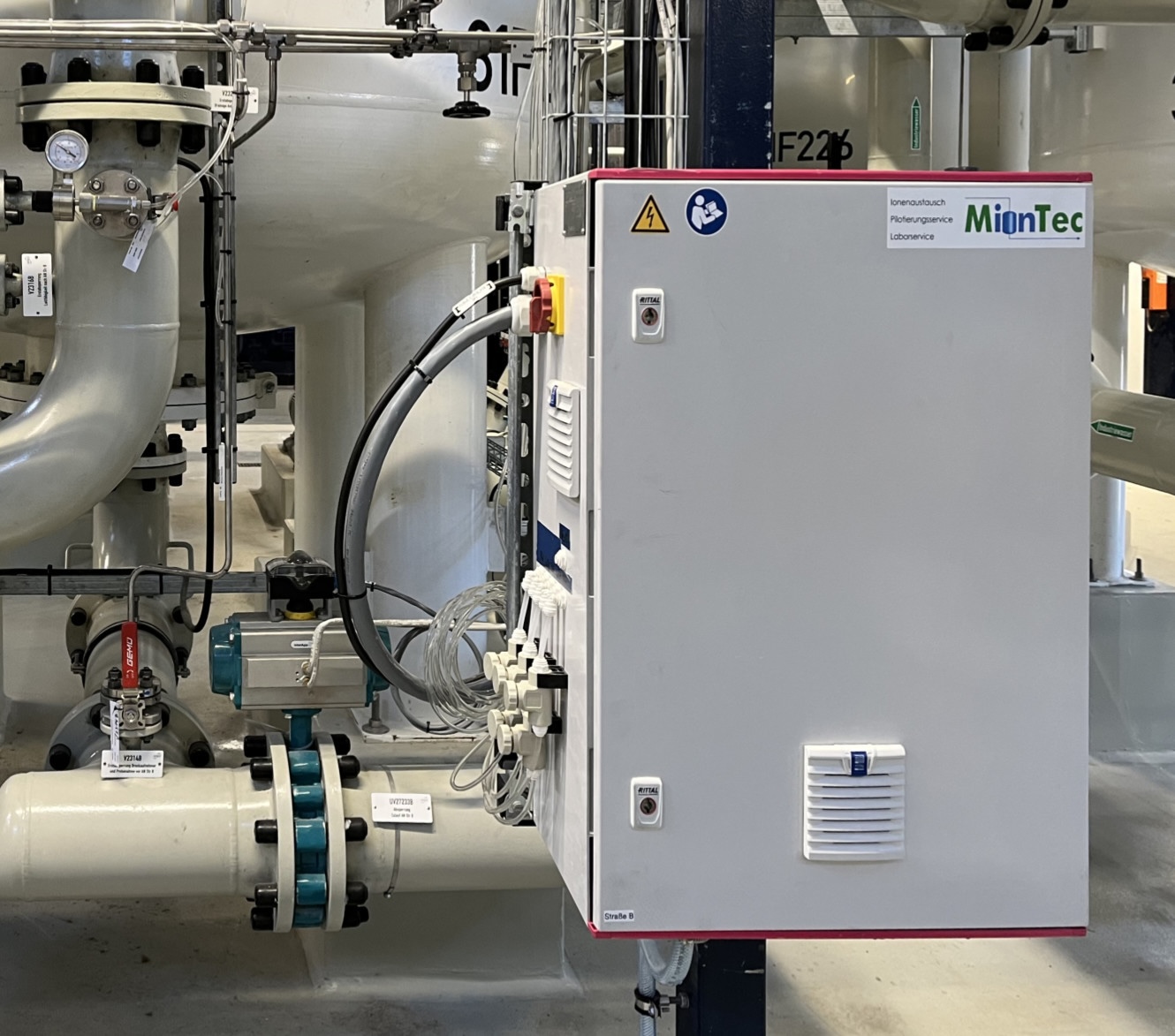
System Technology
Mi-Vision – Making System Processes Visible.
Mi-Vision is a visual monitoring system for DI water treatment plants. It reveals even hidden errors or weaknesses and very often saves enormous chemical costs.
Process Development
LiquiLab – Modular Experimental Technology for Liquid Processes.
LiquiLab monitors, measures, samples, and logs liquid process experimental setups in laboratory format.
Analytics
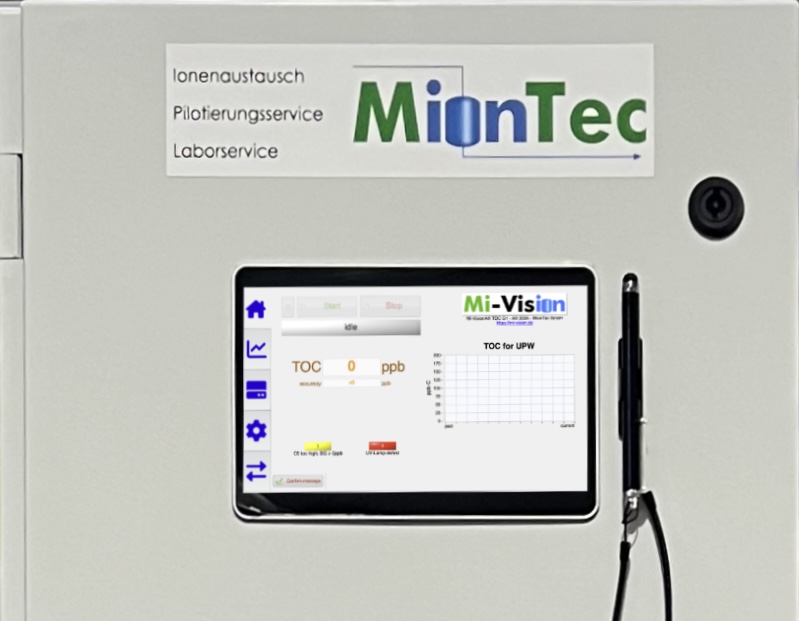
HighResTOC – Precise TOC Measurement for Demanding Processes.
HighResTOC enables high-resolution detection of organic carbon content in liquids. Where previous technology failed due to interfering salt contents, it offers unrivaled resolution.
Our GRP Columns – Durable, Stable, Adaptable.
Our GRP columns were developed for continuous use in ion exchange and adsorption processes.
They are characterized by their cost-saving features such as windows, flanges, manholes, and flat nozzle plates. High chemical resistance, mechanical stability, and low weight are a given.
You will, of course, receive a customized design.
The columns are suitable for both pilot applications and industrial use and can be adapted project-specifically.
"Our Mi-Vision product line is currently conquering the world."
Dieter Mauer
General Manager, R&D, Engineering
Customer Experiences
“With the Mi-Vision system, we gained a much better understanding of the DI plant, and the plant was optimized in terms of scavenger regeneration, throughput, and chemical consumption, which led to significant cost savings. We also gained insights into the condition of the resins in the plant, which helps us with future planning for resin replacement.”

Monika Nielsen
Senior Power Plant Chemist – Ørsted
“For me, Mi-Vision is a perfect tool to repeatedly gain new and exciting insights into our fluidized bed systems. The high-resolution measured values are fully accessible and can therefore be used for evaluations. In addition, a variety of algorithms are already built into the system, e.g., for determining the capacity and aging of all resins, which would otherwise only be accessible with great effort. Thanks to this and the fruitful cooperation with MionTec, we can continuously optimize the operation of our systems.”

Sarah Teizel
Sarah Teizel, Operations Assistant Water Treatment
“As the operations manager of our fluidized bed systems, the most significant advantages of Mi-Vision for me are the savings in regenerant quantities and the more efficient use of the system volume. We can produce more purified water between regenerations and need to regenerate less frequently. For us, this means more economical plant operation.”

Robert Knorsch
Operations Manager Water Treatment
“Last year, we had a 2-day audit of our demineralization plant by MionTec. Instead of an audit, I would rather call this a two-day private training session focused on our plant. Although our plant was running stably and there was no excessive chemical consumption beyond the supplier’s guidelines, the report still identified some significant improvements. Most importantly, however, the key improvements were made possible by the better system understanding I received from Dr. Mauer. Due to the size of our plant, this resulted in an ROI of +- 1 month for the audit, without compromising quality or stability.”
Sam van Nevel
Water-Link
“Vulcan Energy Resources GmbH commissioned MionTec to build the first pilot plant for process optimization of the Zero Carbon Lithium® process.
We selected MionTec from Leverkusen for the planning and manufacturing of our first pilot plant because they possess profound knowledge in the fundamentals of ion exchange and adsorption processes, as well as decades of experience in pilot plant construction. With Dr. Dieter Mauer and his helpful team, we were able to flexibly design the planning phase of the plant and successfully commission it at MionTec on schedule.
The infrastructure of MionTec’s technical center and the use of its chemical laboratory facilitated the smooth commissioning of the pilot plant. Their process technology is designed to be adaptable at any time and at short notice. This type of control technology will ensure the successful process optimization of the patented Vulcan Zero Carbon Lithium® process in the coming months.
We thank the entire MionTec team and look forward to continued good cooperation in the next phases of the Zero Carbon Lithium® project.”
Horst Kreuter
Managing Director Vulcan Energy Resources GmbH
Ready for real clarity?
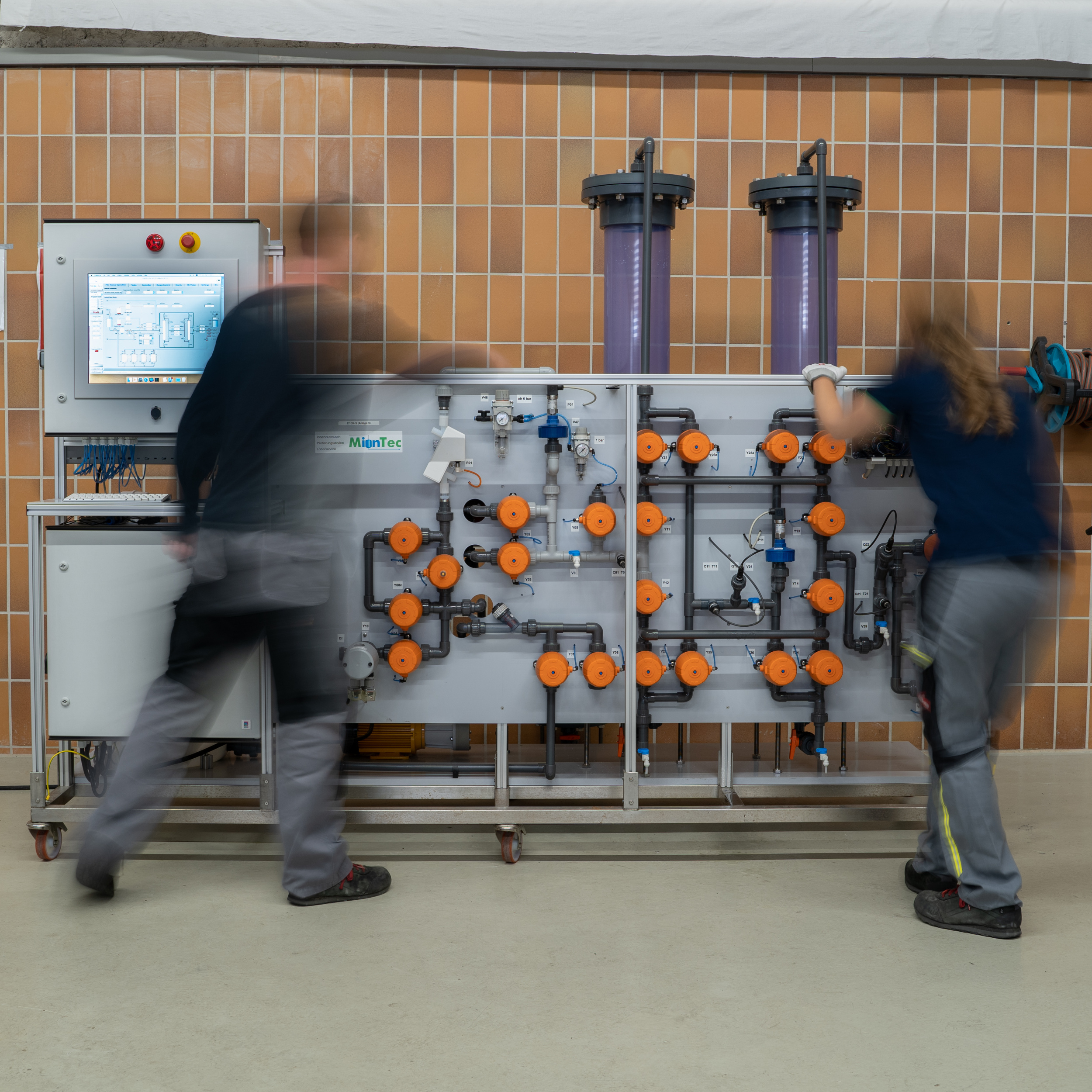
Let us show you how your systems truly run with our MionTec System Audit
FAQ
Mi-Vision
Why Mi-Vision?
Can Mi-Vision save money?
Yes. In recent years, it has saved approx. 40-48% of chemical quantities in some systems. This cannot be guaranteed, of course, as it is not known beforehand how well you had already adjusted your system. However, we will find that out for you in advance.
Why does Mi-Vision increase operational safety?
Can Mi-Vision replace a silicometer?
Can Mi-Vision replace a TOC measuring device?
About the Device
How many components do I need?
Is Mi-Vision adaptable to my DI line?
To date, there has been no type of demineralization line that could not be controlled by Mi-Vision. If you have any doubts, please do not hesitate to contact us.
Can Mi-Vision take over existing measuring points?
Can Mi-Vision affect my DCS or my company network?
No, absolutely not. In the simplest case, the connection to your technology can be established via discrete standard signal lines. Mi-Vision. Center also does not require a connection to your company network. If desired, the discrete lines can be replaced via a ModBus TCP or a Profibus DP coupling. Both systems are point-to-point couplings without the possibility of transmitting data other than those of the defined bus protocols.
Integration
I have several lines. Is Mi-Vision suitable for this?
I have series-alternating circuits. Is Mi-Vision suitable for this?
I have an upstream decarbonization. Is Mi-Vision suitable for this?
Can Mi-Vision also monitor mixed beds?
No, not yet. There are ideas for this, but due to the significantly lower cost relevance compared to demineralization lines, this has not yet been a priority.
Can Mi-Vision also monitor condensate purification?
No, not yet. There are ideas for this, but due to the significantly lower cost relevance compared to demineralization lines, this has not yet been a priority.
I do not have a (modern) DCS yet. Will Mi-Vision still run?
Why HighResTOC?
What is the problem with delta conductivity devices?
Online delta conductivity devices can reach limits of determination around 2 ppb at sample water conductivities below 0.1 µS/cm, and even below 1 ppb at 0.055 µS/cm.
However, in the conductivity range of 0.2…2 µS/cm, the LOD increases to values of 30…300 ppb. This is not yet widely known, but unfortunately unavoidable with technology using only 2 conductivity measurements for physical/chemical reasons.
The main reason is the indeterminability of TIC due to the salt content in the sample stream, which can contain both HCO3– and mineral acid anions. These are indistinguishable.
What relative errors do delta conductivity devices have?
Why does the HighResTOC device have such a low limit of determination?
To the device
What is the difference between HighResTOC.EasyLine and HighResTOC.FlexLine?
What is included in the HighResTOC device?
Does the HighResTOC device need to be calibrated?
Since the measured conductivities are converted directly via water chemistry equations, only the conductivity measuring cells need to be adjusted once upon delivery, along with one pH measuring cell, which even utilizes partial self-adjustment. Typically, control intervals for pH measurement of around one year are achieved.
This means that a TOC measurement value adjustment is not necessary by design. Of course, the device can still be verified (calibrated).
Can the HighResTOC device be calibrated?
Does the HighResTOC device have tamper-proof data storage?
Yes. The measured values are stored in an export/exchange format (CSV) and additionally stored internally. Past internal data can be viewed at any time via the built-in viewer, but cannot be modified.
Integration
Can HighResTOC replace a device with a furnace?
Can HighResTOC replace a delta conductivity device?
Can multiple HighResTOC devices be integrated into an overall system?
Why centralized test monitoring?
What tasks does LiquiLab solve?
What documents does LiquiLab store?
The test plan is saved line by line for each step in a log file. Each test consists of one or more lines within it.
The measurement data is also saved line by line with time stamps in separate measurement data files for each test. Numbered sample events are tracked in a separate column next to these time stamps, so that an assignment of measurement data files and labeled sample bottles is possible at any time.
To the system
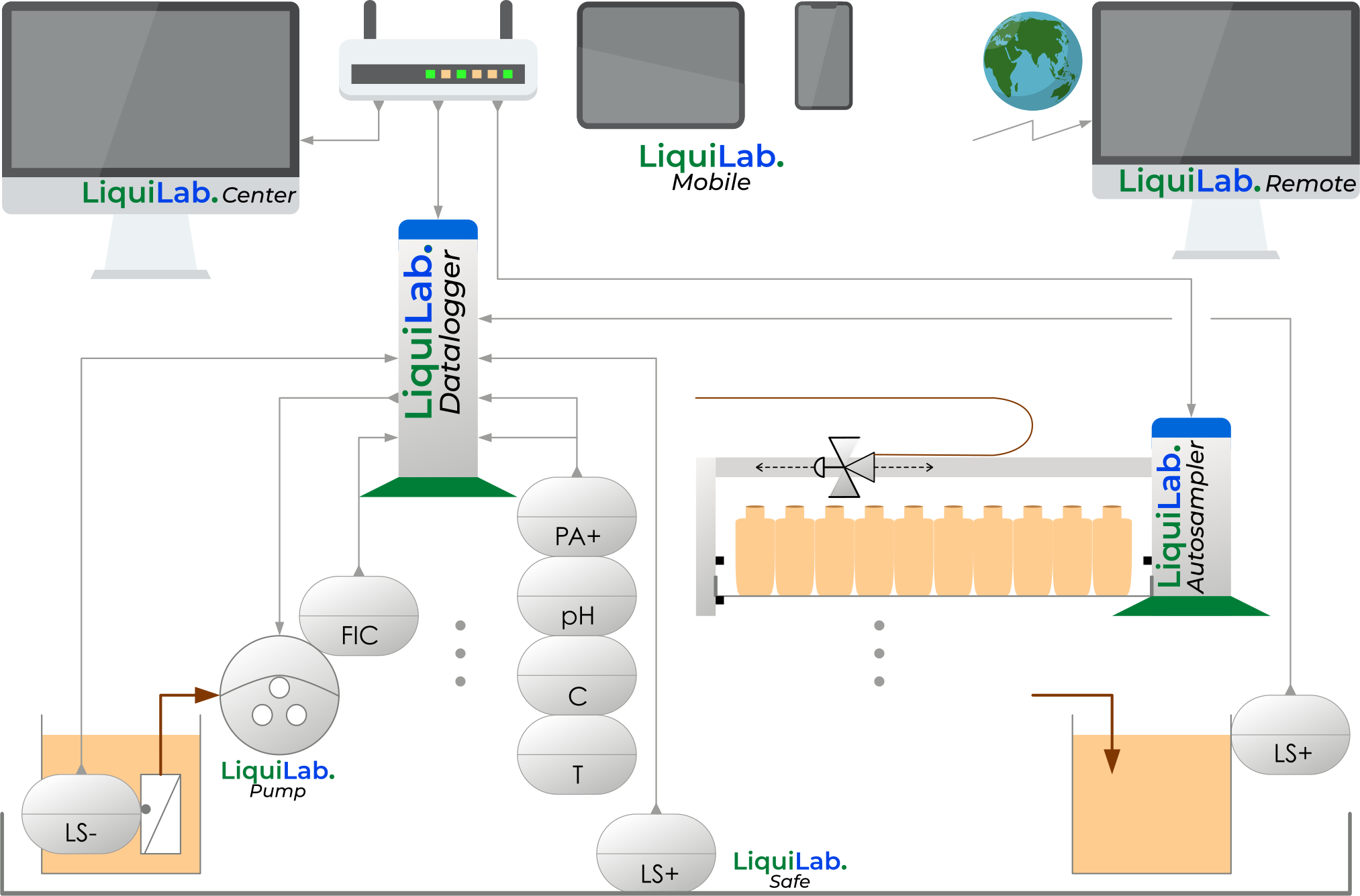
What components does LiquiLab consist of?
The entire system combines 4…5 otherwise independent devices:
– Data logger with up to 16 analog inputs, 4 analog outputs, 8 binary inputs; adaptive sample rate;
– One or more autosamplers with synchronization with measurement data recording, 1…4 measuring points per autosampler;
– 1…4 analog-controllable peristaltic pumps with the possibility of flow control and flow-time control;
– Test monitoring with level-monitored tray, educt tanks with suction lances and min-level shutdowns, product tanks with overfill protection.
– Measurement data logging system with integration of all plan data, measured values, and sample data, printing of sample bottle labels;
How flexible is the LiquiLab.Autosampler?
Since the autosampler is controlled by LiquiLab. Center, variable test plans can be processed, which even include different but documented sample intervals.
Various bottle sizes can be used. Bottle fillings function fully automatically, as the current flows are known.
1…4 different measuring points can be connected to the autosampler via up to 4 hoses. As standard, there are 40 slots for 50 ml bottles, which are automatically distributed among the 1…4 measuring points.
3/2-way valves are used to switch the liquid streams, so that no product quantity is lost and series connections, e.g., of several columns/apparatuses, are possible. Reverse sampling can be selected for multi-column setups.
How flexibly is the LiquiLab.Datalogger equipped?
There is a standard configuration with 4 x LF, 4 x pH, 4 x P, 4 x T. This equipment can be expanded or modified according to customer specifications. All measuring cells are installed in flow-through cells. Please contact us regarding the available materials.
Up to 4 peristaltic pumps can be controlled via pre-assembled interface cables.
Up to 8 level probes can be plugged in and processed.
How does LiquiLab.Mobile access work?
How does LiquiLab.Remote access work?
What safeguards for the test setup does LiquiLab.Safe have?
Test stand monitoring is carried out via
– A level-monitored tray with a conductive or float switch. In the event of, for example, leaking or ruptured hoses, the test is shut down and an alarm is triggered.
– Suction lances with check valves and min-level shutdowns for the educt tanks, so that dry running is not possible. The test can be continued after refilling.
– Overfill protection for product tanks, so that overflowing is not possible. The test can be continued after emptying.
– Bases for components standing in the tray to prevent potential “wet feet.”
Do all components always have to be used/purchased?
No. There is a standard, but deviations can be made according to customer specifications for a certain surcharge for the modification of the documentation.